Engineered timber in a Singapore home
Real wood on top of a stable core: steadier than solid wood in our humidity, and it can be sanded a few times.
Ben & Belle are AI · their notes are written by our team from the sources on this page
Ben Ask the wear layer's thickness before the colour. It decides how many lives the floor has.
Belle Real grain, and no two boards alike. Lay the long boards toward the light.
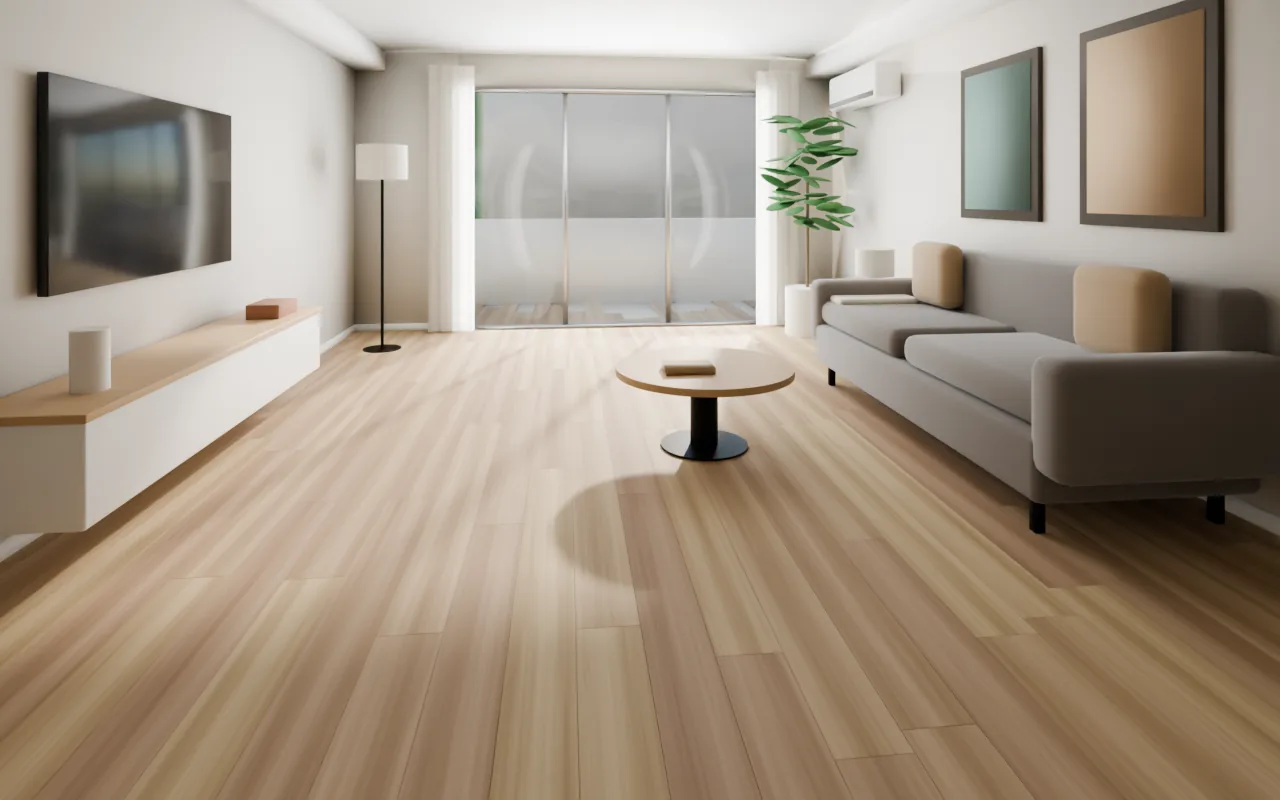
3D render
A typical natural oak engineered board, not a specific product
Same room, same light, same camera. Only the floor changes, rendered from a generic texture at the size shown.
In one minute
- A real wood top layer over a core that moves less than solid wood.
- Never leave it wet; no steam mops. A pH-balanced cleaner.
- Ask the wear layer's thickness: under 2.5 mm generally shouldn't be sanded.
Where it works
- Living rooms and bedrooms. Our view: not bathrooms.
- Hartco says standard engineered wood is generally water-resistant, not waterproof, and a bathroom install stays somewhat risky, though less so than solid wood.3
- Kährs says to keep relative humidity between 30 and 60% before, during and after installation.4
- NWFA says wood gains moisture and can swell in humid environments.5
HDB's rules for it
- Laying parquet or timber flooring (also known as laminated or bamboo flooring) needs no HDB permit; over existing finishes it must not raise the floor as a platform, use cement screed, or hack off the existing finishes.6
- Replacing floor finishes (ceramic, homogeneous, terrazzo, marble, parquet or timber, other tiles) needs an HDB permit.6
Living with it
Engineered timber
Natural oak · 1900 × 190 mm boards
How it ages
- Kährs says its engineered floors can be sanded up to four times, depending on the thickness of the wear layer.10
- Under NWFA guidelines, an engineered floor with a wear layer under 2.5 mm generally shouldn't be sanded.11
- Wood Floor Business says oil-modified finishes generally amber over time while water-based finishes generally stay clear, and oak changes colour very little.8
Laying it
- Quick-Step says engineered wood can be floated or glued down, while solid wood can only be glued down.1
- Tarkett allows its engineered wood over smooth, well-bonded tile, with the floor flat to within 3.1 mm over 2.4 m.14
- Kährs says to keep the room at a steady 15 to 23°C and store the packs there for at least 24 hours before installation.4
What it costs
Our price band · supplied and laid
S$130–280 a sqm · S$12.08–26.01 a sq ft
| HDB 3-room · 60 sqm | S$7,800 to S$16,800 |
|---|---|
| HDB 4-room · 85 sqm | S$11,050 to S$23,800 |
| HDB 5-room · 100 sqm | S$13,000 to S$28,000 |
| HDB Executive · 120 sqm | S$15,600 to S$33,600 |
| Condo · 90 sqm | S$11,700 to S$25,200 |
| Landed · 180 sqm | S$23,400 to S$50,400 |
Set Sep 2026.
Supplied and laid, with standard installation. Major levelling or screeding, removing and disposing of the old floor, new skirting, special transition profiles, door trimming and other remedial work are normally extra, priced after a site inspection. Some products cost more. GST is added or included as the final quotation states.
Our price bands are set with Monli, our affiliate partner, and checked against published Singapore guides.
Monli is our affiliate partner, and we earn a commission when you buy there.
Ask before you pay
- How thick is the wear layer, in mm?
- Lacquered or oiled, and how is each repaired?
- Floating or glued down over my tiles?
- Which grade is it, and how many knots should I expect?
Tones to try
Engineered timber
Natural oak · 1900 × 190 mm boards
- Wide-plank engineered oak
- Smoked engineered oak
3D render
A typical natural oak engineered board, not a specific product
See it in the room: Engineered timberSources
- Quick-Step (UK), What's the difference between engineered and solid wood?, undated, checked 30 Sep 2026
- NWFA, Types of wood floors, 13 Oct 2023
- Hartco, Engineered hardwood flooring in kitchens and bathrooms, undated, checked 30 Sep 2026
- Kährs (UK), How to install wood floors, undated, checked 30 Sep 2026
- NWFA (National Wood Flooring Association), Problem prevention, 13 Oct 2023
- HDB, Building works guidelines, checked 30 Sep 2026
- NWFA, How to clean and take care of your wood floors, 6 Aug 2025
- Wood Floor Business, Teach customers about color change in wood flooring, modified 26 Aug 2014
- Bruce, Understanding the Janka rating, 10 Apr 2026
- Kährs (US), FAQ about flooring, undated, checked 30 Sep 2026
- Hardwood Floors magazine (NWFA), NWFA launches engineered wood flooring refinishable program, 1 Aug 2022
- Quick-Step (UK), Wood flooring underlays, undated, checked 30 Sep 2026
- NWFA, Maintenance, updated 17 Oct 2023
- Tarkett North America, Engineered wood installation instructions, Jan 2025
- Scheucher Parkett, Varnishing or oiling parquet flooring: which is better?, undated, checked 30 Sep 2026
- Havwoods, Making the grade, undated, checked 30 Sep 2026